Article Contents
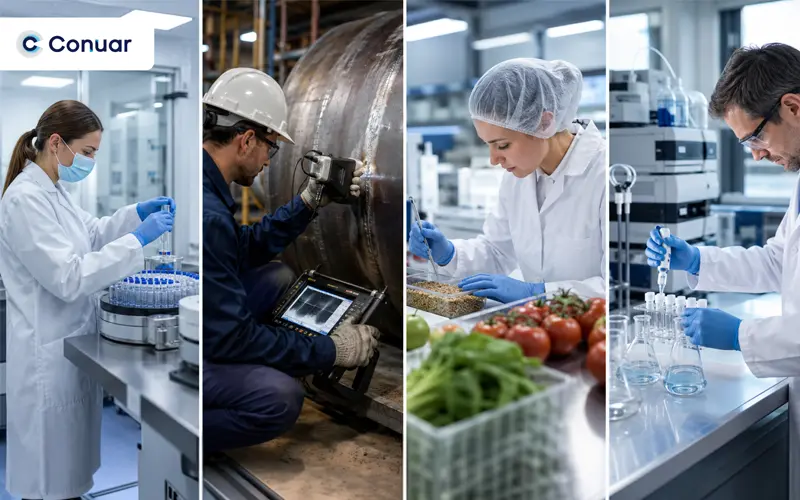
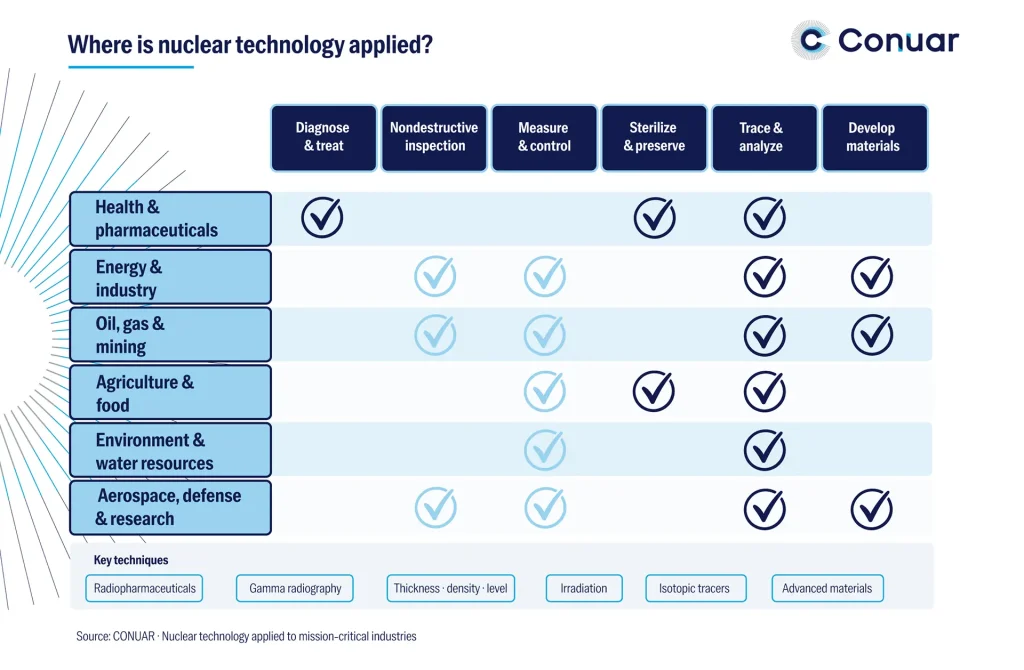
Nuclear technology is used in sectors including healthcare, energy, manufacturing, agriculture, food production, environmental management, mining, oil and gas, research, defense and aerospace.
Its applications make it possible to diagnose diseases, produce radioisotopes, inspect critical components, improve industrial processes, preserve food, study water resources and develop advanced materials.
Nuclear technology extends far beyond electricity generation. It also serves as a scientific, technological and industrial platform for sectors in which precision, safety, traceability and reliability are essential.
What industries use nuclear technology?
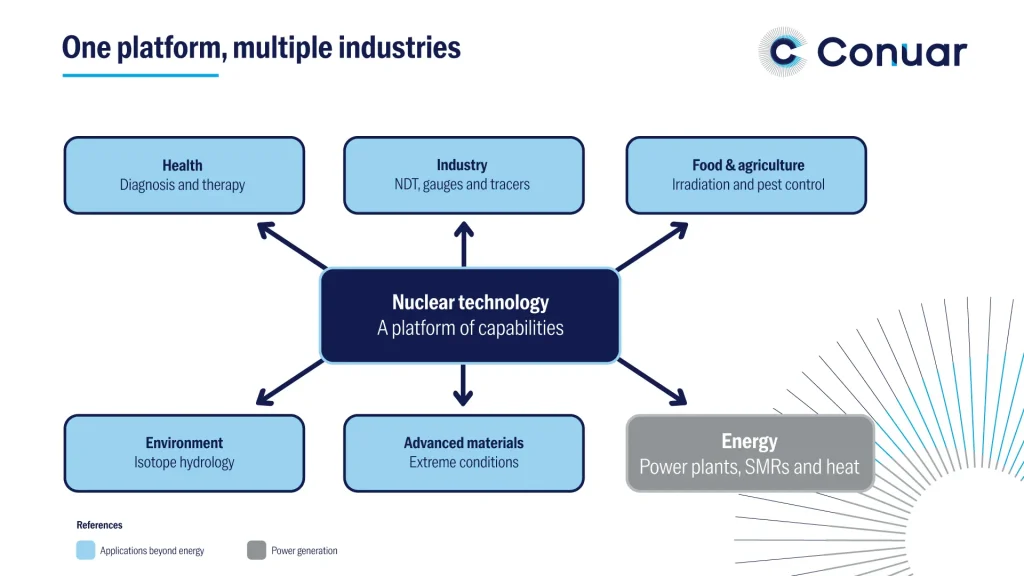
Nuclear technology beyond electricity generation
- Nuclear medicine and radioisotope production.
- Non-destructive testing.
- Sterilization of medical and pharmaceutical products.
- Food irradiation.
- Industrial process monitoring and optimization.
- Materials research and modification.
- Soil and water resource analysis.
- Isotopic tracing and process monitoring.
How is nuclear technology used in medicine?
Radioisotope production and distribution
Radioisotope production requires highly specialized capabilities. Radioisotopes may be produced in research reactors or particle accelerators, followed by processes including:
- Radiochemical processing.
- Quality control.
- Fractionation and preparation.
- Specialized packaging.
- Time-sensitive distribution.
Many radioisotopes have short half-lives, making coordination, infrastructure and local technological capabilities essential to maintaining reliable supply chains.
In Argentina, the National Atomic Energy Commission’s RA-3 research reactor is a strategic asset for the production of radioisotopes used in medical, industrial and scientific applications.
How is nuclear technology used in industry?
In industrial environments, nuclear technologies make it possible to observe, measure and inspect processes without destroying the product and, in many cases, without interrupting operations.
This capability is particularly valuable when working with critical equipment, large facilities, continuous processes and high-value components.
Non-destructive testing
These techniques are used to inspect:
- Welds.
- Pipelines.
- Pressure vessels.
- Metal structures.
- Critical industrial components.
Their main advantage is the ability to detect internal defects that may not be visible through surface inspection alone.
Industrial measurement and process control
Nuclear gauges can be used to measure thickness, density, level and moisture during industrial processes.
These applications are relevant to industries including:
- Mining.
- Pulp and paper.
- Cement.
- Oil and gas.
- Food processing.
- Chemical production.
- Metallurgy.
The information obtained can improve operational efficiency, strengthen quality control and reduce process deviations.
Radioisotope tracers
Radioisotope tracers can be used to study flows, detect leaks, measure residence times, analyze mixing processes, evaluate corrosion and understand the internal behavior of industrial facilities.
Their main advantage is the ability to provide information about real operating processes with minimal intervention and, in certain cases, while the facility remains in operation.
Nuclear applications in food, agriculture and the environment
Food irradiation
Food irradiation can reduce microorganisms, improve food safety, extend the shelf life of certain products and inhibit sprouting in tubers.
The process uses ionizing radiation under controlled conditions and does not require chemicals to be added to the food.
Nuclear technology in agriculture
Nuclear techniques are used in agriculture to:
- Control pests.
- Support plant breeding.
- Analyze soils.
- Optimize the use of water and fertilizers.
- Conduct animal nutrition studies.
- Improve product traceability.
One of the most relevant applications is the sterile insect technique, which is used to control pest populations that affect crops and agricultural supply chains.
Environmental and isotopic studies
Environmental isotope techniques can be used to study aquifers, pollution, soil erosion, sediments, surface water, groundwater and contaminant movement.
Hydrogen and oxygen isotopes, for example, can provide information about the origin, circulation and vulnerability of water resources.
These applications can contribute to challenges related to food security, water management, climate adaptation, agricultural productivity and environmental protection.
How does nuclear research become an industrial solution?
Scientific knowledge alone is not enough to transform a nuclear application into an operational industrial solution. A complete set of scientific, engineering, manufacturing and regulatory capabilities is required.
This development chain may include:
- Applied research.
- Engineering and design.
- Experimental validation.
- Prototype and component manufacturing.
- Licensing and regulatory assessment.
- Radiological safety.
- Quality control.
- Technical documentation.
- Operator training.
- Coordination with end users.
In practical terms, the process begins by identifying a specific industrial problem. The appropriate nuclear technique is then selected, tested, validated and developed into an applicable process, product or system.
The difference between scientific research and an industrial technology solution lies in the ability to demonstrate repeatability, safety, traceability, regulatory compliance and value for the end user.
In the nuclear sector, documentation is part of the product. It is not enough to manufacture a component or apply a technology. Organizations must also demonstrate how it was developed, which materials were used, which procedures were followed, which controls were performed and which acceptance criteria were applied.
Why does nuclear technology require strict safety standards?
Nuclear solutions can offer distinctive technical advantages, including high detection sensitivity, penetration capability, non-destructive measurement, isotopic traceability, heat-free sterilization and controlled material modification.
However, these capabilities can also involve specific safety and regulatory requirements. Some applications may use ionizing radiation, radioactive sources, nuclear materials or regulated facilities.
Depending on the application, requirements may include:
- Authorizations and licenses.
- Radiological protection.
- Personnel training.
- Dosimetry.
- Radioactive source control and tracking.
- Waste management.
- Regulated transportation.
- Physical security.
- Documentation and auditing.
- Oversight by the relevant authorities.
Nuclear technology can provide unique capabilities, but it also requires a rigorous culture of safety, quality and regulatory compliance.
New opportunities for nuclear technology
The energy transition and the technological transformation of industry are creating new opportunities for nuclear capabilities and related technologies.
Materials for extreme conditions
There is growing demand for materials capable of operating under radiation, high temperatures, pressure, corrosion and other extreme conditions.
These developments are relevant to:
- Advanced reactors.
- Fusion technologies.
- Hydrogen production and use.
- Energy storage.
- Aerospace applications.
- High-performance industrial systems.
Advanced nuclear medicine
The expansion of therapeutic radiopharmaceuticals and theranostic approaches is creating opportunities to develop regional supply chains for critical medical radioisotopes.
Advanced reactors, SMRs and microreactors
Small modular reactors and microreactors may combine electricity generation, industrial heat, radioisotope production, materials research and energy solutions for isolated locations or energy-intensive industries.
Capabilities transferable to other industries
- High-complexity engineering.
- Precision manufacturing.
- Testing and technology validation.
- Documented traceability.
- Quality management.
- Specialized materials.
- Instrumentation and automation.
Lessons from Argentina’s nuclear technology ecosystem
Argentina’s experience demonstrates that complex technologies are not developed in isolation. They require continuity, skilled professionals, scientific infrastructure, industrial capabilities, regulatory organizations, technology companies, universities, research centers and end users.
Argentina has significant experience in:
- Research reactors.
- Radioisotope production.
- Nuclear medicine.
- Nuclear power plants.
- Engineering and manufacturing.
- Nuclear regulation.
- Scientific and technical education.
This ecosystem has sustained strategic capabilities for decades and generated knowledge that can be transferred to other productive sectors.
Nuclear technology is not only a scientific discipline. It is also an industrial development platform. Its growth strengthens capabilities that can be applied to healthcare, energy, environmental management, advanced materials, aerospace, defense, hydrogen and advanced manufacturing.
For an industrial company such as CONUAR, this approach is fundamental. Its experience in engineering, manufacturing, quality, documentation, materials and compliance with demanding standards supports the development of new nuclear applications and related technologies.
Nuclear technology as an industrial development platform
Nuclear technology is much more than electricity generation. It is a cross-sector tool for addressing specific challenges in healthcare, industry, environmental management, energy and technological development.
Its future potential will depend on the ability to integrate science, engineering, infrastructure, industry and long-term strategic planning.
At CONUAR, capabilities developed within the nuclear industry support projects that require precision, safety, traceability, technical documentation and demanding quality standards.