CONUAR has developed an in-house automated industrial inspection system designed to validate more than 20 quality items per fuel assembly, integrating machine vision, laser triangulation and 3D profilometry. The result is increased production throughput with uncompromised nuclear safety, repeatability and traceability.
From manual inspection to automated industrial control
In the nuclear industry, quality is not a downstream check—it is a structural requirement of the supply chain. At CONUAR, the decision to inspect 100% of fuel assemblies (FAs) establishes a demanding standard that, as production volumes increase, requires a transition from manual inspection schemes to systematic, automated industrial inspection.
This need led to the development of CONUAR’s Fuel Assembly Control Tower, an internal project designed to eliminate inspection bottlenecks, professionalize data acquisition and sustain higher production rates without compromising nuclear-grade quality or safety.
The project represents a clear paradigm shift: inspection no longer depends on human fatigue or subjective judgment, but on identical measurement cycles, sensor-based verification and fully auditable digital records.
High-throughput production under increasing nuclear requirements
Increasing production pace in a nuclear environment introduces a critical tension: more units per day with equal or higher quality assurance. In this context, inspection cannot become a limiting factor.
The Control Tower enables the transition from inspector-based evaluation to sensor-based objectivity, ensuring that higher throughput does not come at the expense of safety, compliance or reliability.
More than 20 inspection items and a zero-failure philosophy
Each fuel assembly is automatically verified against more than 20 inspection criteria, combining:
- Dimensional controls for precise measurements
- Visual inspections for surface condition, integrity and damage detection
Automating this diversity of checks in a nuclear environment presents a significant challenge. What the human eye resolves intuitively must be translated into specific measurement technologies and algorithms, all under a strict zero-failure requirement.
The final system architecture adopts a multimodal inspection approach, integrating:
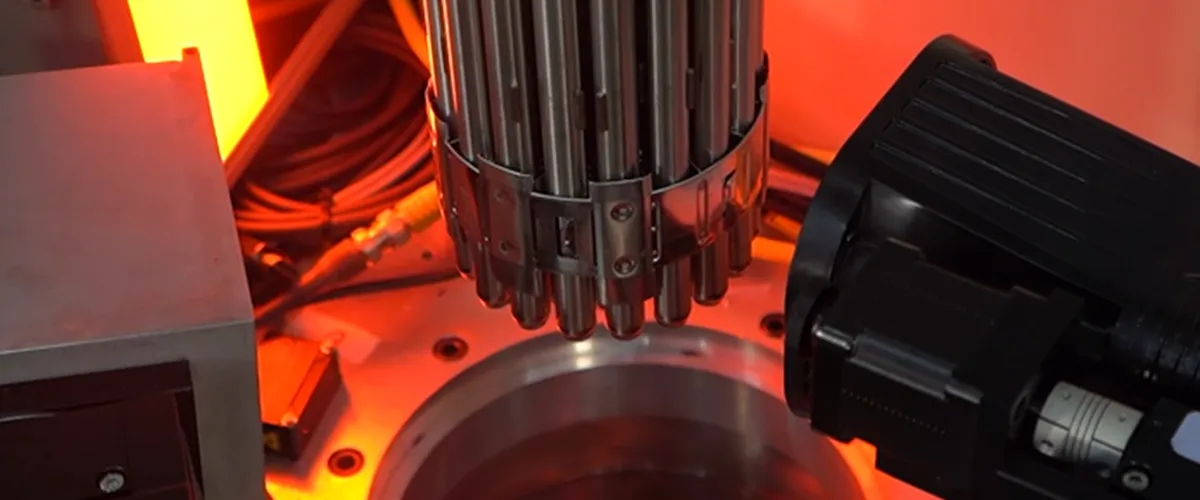
- Laser triangulation for high-precision positioning
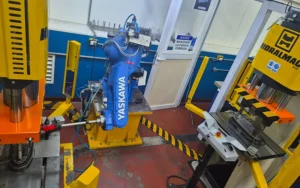
- 3D profilometry assisted by a robotic system for complex geometries
- High-resolution industrial cameras for critical visual inspections
No single technology was sufficient on its own. The solution lies in their intelligent combination.
Validated acceptance criteria and full digital traceability
Acceptance criteria were defined and validated using fuel assembly dummy units for sensor calibration and measurement tuning. Validation was performed in close collaboration with Quality Engineering and Metrology, benchmarking automated measurements against certified traditional methods.
Traceability is ensured through dedicated control software that records the complete inspection dataset for each fuel assembly. Every unit is assigned a tamper-proof digital “birth record”, enabling full auditability across the nuclear supply chain.
A key engineering decision: move the observer, not the object
Fuel assemblies are slender and heavy structures. Rotating them during inspection introduced micro-oscillations that degraded measurement accuracy.
The adopted principle was simple: If the object becomes unstable when moved, move the observer instead.
By keeping the fuel assembly static and rotating the measurement systems around it, CONUAR achieved an ultra-stable measurement reference, transferring complexity to the mechanical design of the rotating inspection carriage.
Mechanical, electrical and software integration beyond 360°
Integrating multiple sensors and cameras into a system capable of continuous rotation beyond 360° required detailed engineering, particularly in:
- Cable management and data transmission without mechanical fatigue
- Vision-system software integration and synchronization
- Self-diagnostics and repeatable measurement cycles
Robustness was engineered from the outset, with early involvement of Process Engineering and Maintenance, ensuring long-term industrial operation.
A cross-functional development model
The Control Tower was developed as an integrated internal task force, with clearly defined roles:
- Process Engineering: definition of functional requirements
- Project Engineering: hardware and software development
- Quality & Metrology: validation of inspection criteria
- Procurement & Logistics: acquisition of specialized technologies
- Maintenance: long-term operability and sustainability
The key management insight was clear: true ownership combined with transversal communication.
Industry 4.0 projection and technological scalability
This development confirms that CONUAR is not only a manufacturing facility, but a technology development center capable of creating bespoke solutions where no off-the-shelf equipment exists.
Each automatically inspected fuel assembly contributes to a high-precision dataset enabling:
- Advanced analytics
- Predictive maintenance
- Upstream process optimization
- Future AI-based quality models
By design, this automated inspection architecture is transferable to aerospace, automotive and energy industries, where traceable and auditable quality is critical.